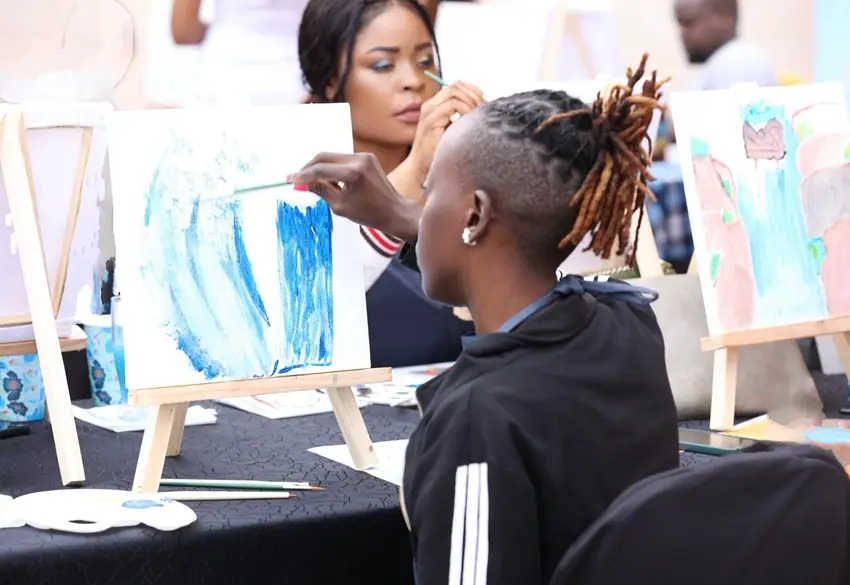
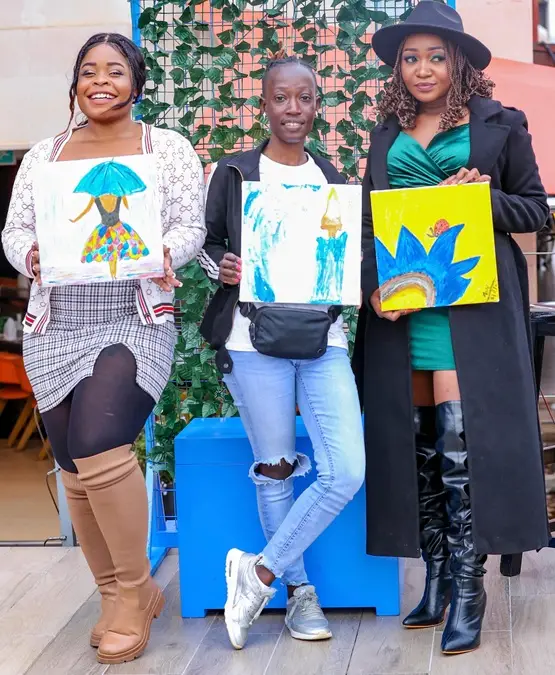
In the heart of Nairobi, where life hums with a relentless rhythm, I often find myself craving a moment of stillness. It’s not that I dislike the city’s vibrant chaos—far from it. I thrive in the pulse of matatus blaring their eclectic beats and the swirl of chatter in the bustling markets. But sometimes, the weight of my work life with its notifications, deadlines, and endless to-do lists, becomes too much. That’s when I discovered art—not just as a pastime but as a refuge.
It began with a visit to a quiet gallery tucked in the city’s corners, a space that felt like stepping into another world. There, surrounded by colors and textures, I found a sense of calm I didn’t know I was searching for.
Peace in the Pallett
They say art is the voice of the soul without words, and I didn’t realize this enough until I was in front of a picture that represented everything that I could not say. The painting was very chaotic -the whole picture was definitely a worse storm experience than I’ve ever had.
The brush strokes were messy and the colors were muddy. But with all that, it was as if I was detached from the world noises and felt like I could understand life in a more abstract way as a consequence. I instantly grasped in that moment that art isn’t always a source of pleasure; it can also serve as an antidote to our morale hits. It’s true that to understand our emotions completely, there are circumstances where we only have to express our creativity.
The Roots of Art Therapy
While art therapy may seem like a modern concept, its roots trace back to the mid-20th century.
The idea gained ground during World War II, when British artist Adrian Hill discovered that creating art helped him cope with tuberculosis. Hill’s work with other patients showed him the therapeutic power of self-expression through art. This was the birth of art therapy, a practice that turned emotional struggles into creative healing.
"Art heals. From chaotic brushstrokes to soothing textures, creativity becomes a refuge, transforming emotions into clarity and nourishing the soul." #ExploreWithQuinter 🎨
Bridging History with Healing
Margaret Naumburg, the “mother of art therapy,” took Hill’s ideas further, believing that art could tap into the subconscious in ways words couldn’t. I often think about her, especially on those days when words can’t capture the emotions I’m experiencing. She was ahead of her time, understanding that art could be a bridge between our conscious thoughts and our deeper feelings.
The Healing Brush Stroke
Art has become a space where one can process emotions, untangle my thoughts, and find clarity. Every brushstroke, sketch, or splash of color feels like a conversation. Even when life feels overwhelming, art offers a way to release stress and find balance. It’s more than just a hobby—it’s a tool for healing.
What a Journey!
By indulging in art, I have discovered the most unknown corners of myself and my inner world. Art is not only a medium to articulate beautiful images but an instrument to interact with my mind and to fathom my feelings in a more profound way.
The arts have shown me that the recovery process can be both clinical and unstructured; healing can be free-flowing and expressive like the art itself. Whenever I need to feel at peace or when I’m floundering to make sense of things, art always becomes the path returning me back to calm.